
The comparison between natural leather and synthetic materials is often reduced to a simple matter of aesthetics or price. In reality, there are profound structural differences involving chemical composition, behavior over time, environmental impact, and the overall quality of the user experience.
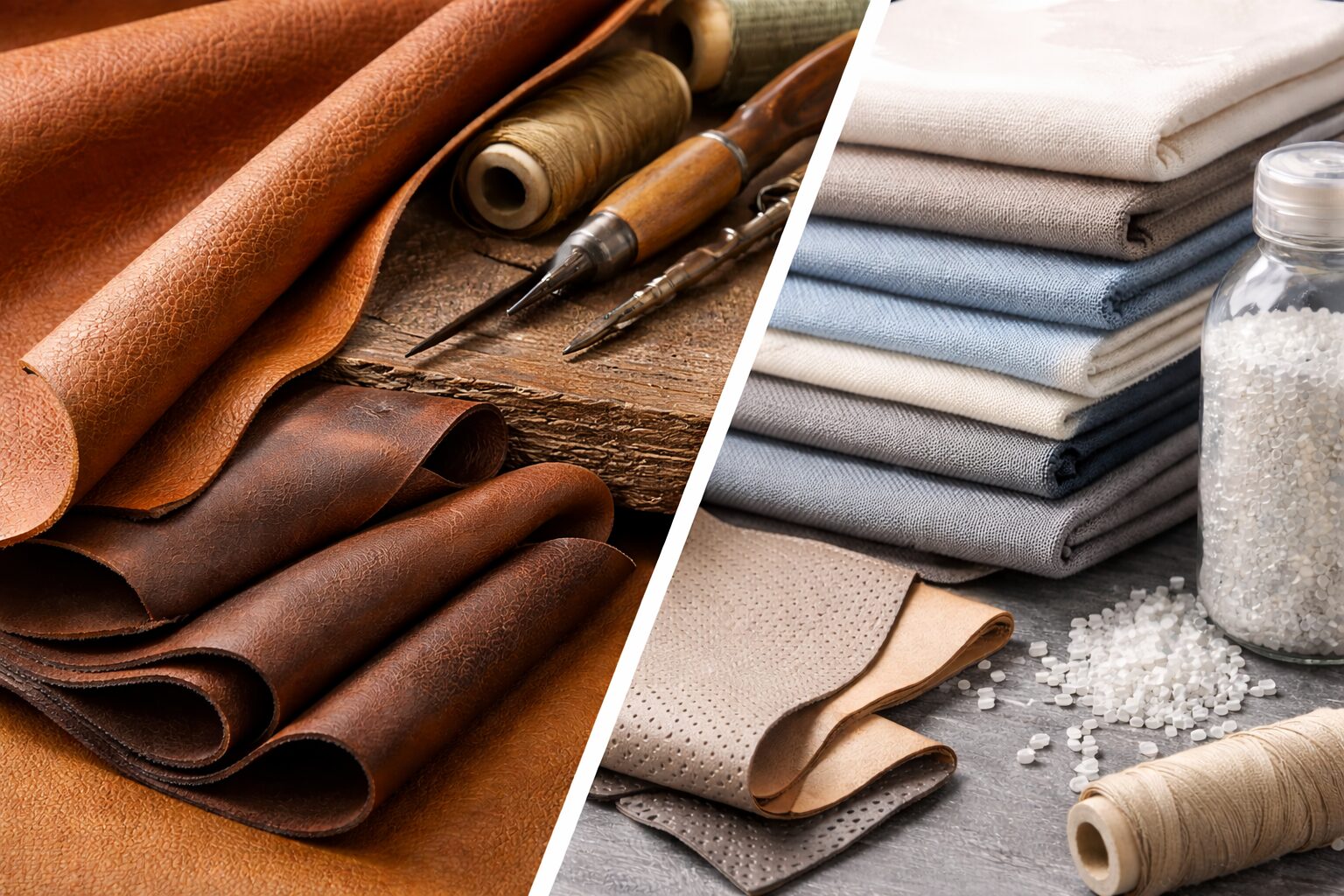
Molecular structure: collagen fibers vs. plastic compounds
Natural leather consists of a complex, three-dimensional network of irregularly woven collagen fibers. This organic structure provides the material with elasticity, tensile strength, and high adaptability. When leather is under mechanical stress — such as the seating area of a sofa — the fibers compress and release without breaking easily.
Synthetic materials, such as polyurethane (PU) or PVC, are plastic compounds with a homogeneous, non-fibrous structure. This difference drastically affects durability: under stress, synthetics tend to crack, peel, or lose their surface layer over time, particularly in areas subject to high mechanical wear.
Thermal comfort and breathability
A decisive factor in the choice is breathability. As a natural, porous material, leather allows for a constant exchange of moisture and air. This contributes to superior thermal comfort:
- In winter: leather is not as cold as people think, as it quickly adapts to body heat.
- In summer: high-quality leather does not feel excessively sticky.
In contrast, petroleum-derived synthetic materials are generally less breathable, which can limit comfort during prolonged use.
Sustainability and environmental impact: a balanced view
From an environmental perspective, natural leather is a by-product of the food industry. Livestock are not raised specifically for leather; instead, the industry utilizes an existing raw material that would otherwise become waste. Synthetic materials, on the other hand, are derived from petrochemical processes.
However, true sustainability depends on supply chain management. Responsibly tanned leather produced in environmentally controlled systems offers an extremely long lifespan, drastically reducing the need for replacement. Conversely, an inexpensive synthetic material that requires frequent replacement can have a greater overall life cycle impact.
The perceptual dimension: uniqueness vs. uniformity
Finally, there is the sensory dimension. Natural leather features micro-variations, pores, and small irregularities that create visual depth and tactile richness. This "imperfection" is the hallmark of its authenticity. While synthetics can mimic surface appearance, they tend toward a flat uniformity that rarely replicates the same sensory complexity.
The choice between natural leather and synthetics is not just technical but cultural: it means deciding between a living material that evolves over time or a stable but less durable surface.